Karn Saroya on Bankless
Re CEO Karn Saroya joined the Bankless podcast to explain how Re is building an onchain reinsurer modeled on Lloyd's of London, bringing transparent, stablecoin-backed capital to a $700B market.
Karn Saroya
on Bankless.
Reinsurance, onchain capital, and the future of Re.
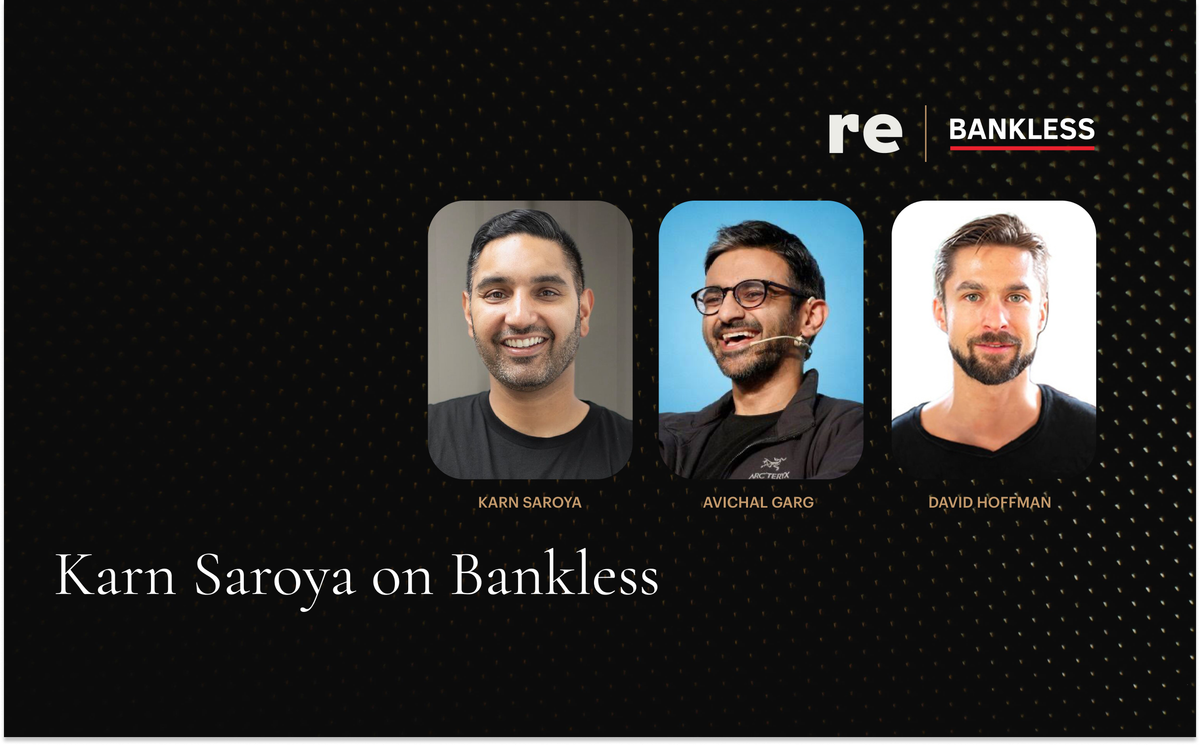
Re CEO Karn Saroya joined David Hoffman on Bankless alongside Avichal Garg, founder and general partner at Electric Capital, to explain what Re is building, why onchain reinsurance is such a large opportunity, and what the $RE token is designed to do.
What Re Is
Karn opened with the clearest version of the pitch: Re is an onchain reinsurer. Stablecoins come in, are transferred to partner reinsurers to serve as collateral to back reinsurance contracts, those reinsurers collect premiums, and the economics flow back to the onchain capital layer.
At the time of recording, Re Protocol's capital was backing contracts with over 30 insurance carriers through partner reinsurer Cover Re. These contracts amount to roughly half a billion in progress, with the protocol targeting one billion over the following seven months.
The reinsurance market itself is enormous and largely invisible. About a trillion dollars in reinsurance premium is processed annually across industry giants like Munich Re, Swiss Re, and Lloyd's of London.
"Being onchain and utilizing onchain capital is probably the most elegant use case of onchain capital. We take in capital that anyone in the world can see at any given point in time. Regulators, insurance company customers, anyone with a computer can see that we are good for the promise and that we're solvent at any given moment."
Karn Saroya, CEO of Re
Why Blockchain Is the Right Infrastructure
Avichal framed it from an investor's perspective: from the outside, Re looks like a standard reinsurance business. But two things make it structurally different.
The Market Opportunity
The reinsurance market is roughly $700B in annual premium globally. Below it sits a larger insurance market of seven to eight trillion. Karn noted that the combined ecosystem represents roughly 12% of global GDP, a figure Avichal suggested could be read even higher if one counts governments as the ultimate backstop for large-scale risk.
Re's current portfolio focuses on low-volatility, catastrophe-lite lines: auto, home, workers' comp, commercial property. High-volatility, binary-outcome risks like earthquakes or hurricanes come later, once the infrastructure and underwriting relationships are in place.
"You want to build the muscles. You want to attract the underwriters around the world that have the specialty in a particular domain, so that they can tap this and deliver economics rather than trying to build that muscle entirely yourself."
Karn Saroya
Lloyd's of London as the North Star
One of the most interesting threads in the conversation was the comparison between Re and Lloyd's of London. Lloyd's is a 330-year-old insurance marketplace that evolved from London coffee houses into one of the largest insurance markets in the world, with roughly 103 distinct underwriters globally, governed through a council that decides counterparty requirements, capital standards, and acceptable lines of business.
"The Lloyd's market, much like the Re protocol, dictates who the acceptable counterparties are, lines of business, capital requirements, and has a governance council that oversees all of this, and behind it a very large pool of capital that secures the network. A ton of our own inspiration comes from Lloyd's. That is the North Star for us."
Karn Saroya
Avichal took it further. When he first understood Lloyd's structure, his reaction was that it looked like a DeFi protocol: a large pool of capital, a governance council, underwriters pitching to the pool, segmented risk.
The long-term vision for Re is an internet-native capital market for all of insurance, not just reinsurance. Bermuda and Cayman reinsurers are already approaching Re with interest in tapping into the onchain capital pool. Re's vision is an onchain Lloyd's of London: a common capital pool that can feed any insurer and any reinsurer in the world.
The Capital Structure
Karn walked through how the money flows. There are three layers:
What the $RE Token Does
The $RE token is a governance token for the Re ecosystem, modeled explicitly on Lloyd's governance structure. It dictates who the acceptable counterparties are, what lines of business are permitted, what capital is required, and governs the size and release schedule of the common pool.
$RE holders decide which reinsurers and capital providers are acceptable counterparties. This is the same function Lloyd's governance council performs for that market.
What risks the protocol will back (auto, property, workers' comp, and eventually specialty lines) is a governance decision, not a unilateral one.
The size, composition, and release schedule of the common capital pool, potentially tens of billions, is governed by $RE token holders.
"It has the potential to be an enormous sum of money that protects tens of millions of people around the world. Every asset manager and every reinsurer and insurance company in the world should be interested in this."
Karn Saroya
Controlling the parameters of what could become the largest insurance capital pool in the world is a different kind of governance than simply voting on protocol parameters with no underlying economics.
What Karn Is Focused On
With the $RE TGE complete, the focus now is scaling the business ahead of the January 1, 2027 insurance market renewal cycle, the moment when the largest contracts in the industry are renegotiated.
"We're no longer a toy. We're no longer conceptually interesting. It is a real market player with real market access and capital to boot."
Karn Saroya
Watch the full conversation.
Important Disclosures
About Re and Cover Re. "Re" refers to the Re Protocol, onchain infrastructure operated in connection with Resilience Foundation Cayman LLC ("Resilience Foundation"), an Exempted Limited Guarantee Foundation Company incorporated in the Cayman Islands with Limited Liability with registered number IC-414560, and its affiliates (including Resilience BVI and Resilience Inv). "Cover Re" refers to Cover Re SPC, a separately regulated reinsurance entity. Re and Cover Re are distinct brands operated by separate legal entities with separate functions, terms, and regulatory regimes. References to reinsurance treaties, insurance partners, policyholders reinsured, business written, or book size refer to activities of Cover Re SPC, not the Re Protocol. References to onchain capital, the protocol, and token-related activity refer to the Re Protocol.
No offer; eligibility restrictions. This article is for informational purposes only. It does not constitute an offer to sell, or a solicitation of an offer to buy, any security, token, insurance product, or reinsurance capacity, and is not investment, legal, tax, accounting, or financial advice. reUSD and reUSDe are available only to non-U.S. persons in specific geographies through Resilience Foundation and are subject to eligibility screening, including KYC/AML procedures. Nothing in this article should be read as making any product or token available to any person in a jurisdiction where such offering would be unlawful.
Risk. Participation in the Re Protocol and holding of digital assets, including reUSD and reUSDe, involve significant risk, including risk of total loss of principal, smart contract vulnerabilities, regulatory risk, liquidity risk, counterparty risk, and reinsurance underwriting risk. APR, yields, and returns are not guaranteed. Past performance is not a reliable indicator of future results. Any historical figures referenced reflect data over the period stated and are not projections.
Forward-looking statements. Statements regarding the partnership, planned functionality, future governance phases, or other future events are forward-looking and based on current expectations. Actual results may differ materially. Re, Cover Re, and their affiliates undertake no obligation to update any forward-looking statements.
Regulatory environment. The legal and regulatory treatment of digital assets, governance tokens, stablecoins, and onchain reinsurance is evolving. This article reflects our understanding as of the date of publication and may not reflect subsequent legal or regulatory developments, including any further guidance under the joint SEC/CFTC Interpretive Release (Release No. 33-11412; 34-105020; File No. S7-2026-09). For full Terms of Service, Privacy Policy, and detailed risk disclosures, see re.xyz/terms.